


Release notes for the Genode OS Framework 26.11
On this year's roadmap, we stated the building of bridges as overarching motive for 2026. This final release of the year presents the culmination of these efforts in the form of an SDK that is able to run directly on Genode, and Sculpt OS in particular. Development workflows that were previously contained in Linux VMs can now be cultivated directly under Genode. This endeavor required both the porting of all the tools we love using every day as well as nurturing Genode's POSIX emulation to a level that is able to carry these loads. (Section Goa SDK hosted directly on Sculpt OS)
As the second highlight, the release takes Genode's concept of pluggable drivers - that we previously applied for audio, networking, display, and input - to USB, effectively taking the liveliness of the USB host-controller driver off the critical path of applications depending on USB, which is a huge gain in terms of fail-safety (Section Microkernelized USB).
The release is rounded off by new support for Intel Panther-Lake platforms, USB audio, and the completed transition from XML to Genode's custom HID syntax.
Microkernelized USB
USB support has a long history within the Genode OS framework. Starting with a simple monolithic approach in 2009, it has evolved into a hierarchy of lots of distinct components. There are separate components to drive a specific USB interface class like mass-storage or Human-Interface Devices (HID), either written from scratch, ported from Linux, or using a port of the libusb library. Additionally, the virtual-machine monitors VirtualBox and Seoul can pass through whole USB devices to guest OSes by re-using a Qemu-based USB host-controller model.
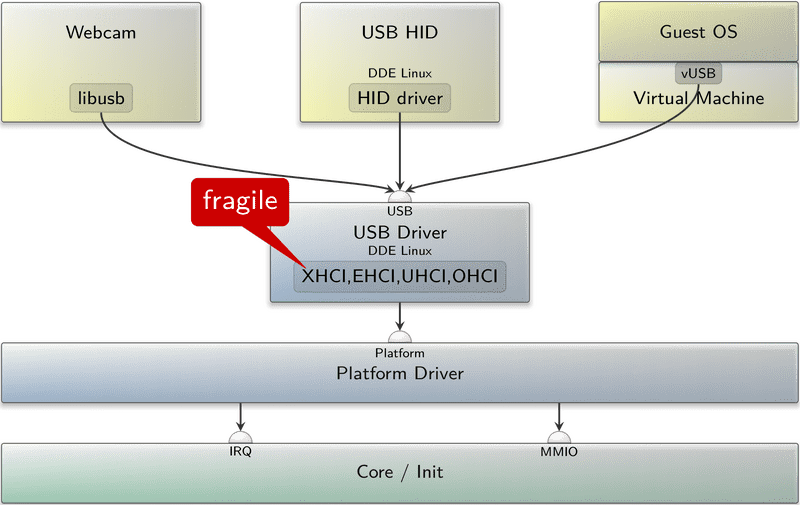
All those distinct components drive different USB devices that might be connected to one and the same bus. The link between those different USB device drivers is the USB multiplexer. Up until now, the multiplexer interacted directly with the USB host-controller hardware that arbitrates the actual bus access.
|
|
The USB host driver as a complex single point of failure
|
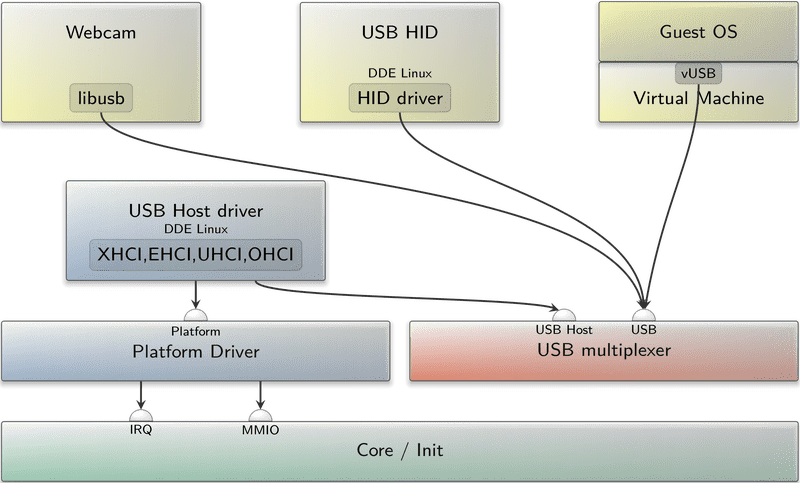
To take this design to the extreme, we've now extracted the USB host-controller driver out of the USB multiplexer. Similar to the GUI and network multiplexers, the USB multiplexer component has become a pure policy-driven control unit that is hardware independent. Whereby all hardware-specific driver implementation details reside in client components of the USB multiplexer, including complex protocols, quirks, and heuristics. The most welcome and interesting side effect of this change is that the lifetime of a device-client is no longer dependent on the lifetime of the USB host-controller driver. A failure or scheduled shutdown of such driver no longer results in an implicit destruction of the client component. From the client's perspective, it looks like the device has vanished momentarily, just the same as when the device gets unplugged.
|
|
The USB host driver having become pluggable
|
New USB host service
To realize communication between the new USB multiplexer and drivers of USB host-controller hardware, a new interface is now provided by the "Usb_host" service. The former "Usb" service interface remains unaffected, and USB-device clients follow the same protocol as before.
Clients of the host service and the multiplexer communicate via two shared-memory buffers. One dataspace that is mutable by the client is used to announce all USB devices a host client has detected to the multiplexer. This report contains all necessary information including valid device configurations, their interfaces and endpoints. Whenever a new device gets plugged, or an existing one vanished, the dataspace content is updated by the client, and the multiplexer is informed via an RPC-call.
The second dataspace is immutable by the client and contains requests of the multiplexer to either acquire or release a device, or one of its interfaces. Each request contains an ID that is used by the client to obtain additional ingredients used to establish a communication channel by the device-client that wants to drive a device or interface. The host client collects a dataspace and signal-context per device resp. interface channel from the multiplexer using the ID of the request. When a channel is established, the host-client informs the multiplexer via RPC-call about the finalization of the acquisition request. And vice versa, the host-client informs about a finished release request after cleaning up its communication channel.
Both data channels, the device-announcement, and the multiplexer-requests are represented as human-inclined data. The actual USB protocol data does not flow between the multiplexer and the host-client, but directly between host- and device-clients.
More participants, strong control, but zero-copy
Obviously, extracting the USB host-controller driver part out of the USB multiplexer, and assigning it a new client-role increases the complexity of the interplay. Now there are at least three instead of two components involved. But the complexity of the USB multiplexer gets decreased, which is the anchor that all other related components depend on. Also, the USB multiplexer is only involved in the setup and the teardown of communication relations of host-controller drivers and device-clients. Dependent on its configuration, it presents parts of the announced devices to its device clients. It acts upon the dynamics of its policy and the presence of devices. Being the owner of all communication buffers, it can withdraw them at any time, thereby effectively cutting any relation. Moreover, when establishing a new communication channel, the multiplexer requests a DMA-capable memory buffer on behalf of the USB host-controller, whose device got requested. This DMA buffer, which is designated as communication buffer between the host-controller driver and the device client, provides the opportunity to follow a zero-copy approach.
One USB device with several clients
Until now, it was not possible to assign one and the same USB device to different device-clients, even though those clients drive distinct interfaces. This has changed now. The new USB multiplexer allows for the assignment of one device to multiple clients under the condition that the clients behave cooperatively and do not mutually affect each other. For example, we experimentally assigned a USB headset to the USB HID and the USB Audio driver concurrently, and successfully received button events while playing music. Nevertheless, device sharing is still in a highly experimental state. It is not predictable what happens if different clients do not behave cooperatively. Additional safety nets are planned for the upcoming release, such that it will be possible to assign one primary (privileged) device-client and less privileged secondary roles.
Goa SDK hosted directly on Sculpt OS
For several years, all developers in the Genode team have been using Sculpt OS as a daily driver but had to rely on the assistance of virtual machines for Genode development. Hosting heavy workloads natively on Sculpt is still an ongoing effort. The Falkon web browser is a prominent example of the transformation from using virtual machines as crutches towards running those workloads directly on Sculpt.
By hosting the Goa SDK directly on Sculpt OS 26.10, we continue on our theme of "eating our own dog food" that originally spurred Sculpt OS in the first place. It constitutes an essential milestone that enables an on-target development workflow without the help of a development VM.
If you followed our road map and past release notes, you will have noticed that this was not a low-hanging fruit. The endeavor included porting a bouquet of Unix tools - such as CMake, Sequoia PGP, expect - stressing our C runtime and VFS with their interoperation. The porting efforts were greatly assisted by the off-target version of the Goa SDK and - in turn - not only left their mark on Genode-world (Section Libraries and applications) but also on the Goa SDK itself (Section Goa SDK).
Sculpt 26.10.1 comes with a ready-to-use preset for the Goa SDK, which you can find introduced in the following article.
- Goa SDK hosted on Sculpt OS 26.10
Base framework and OS-level infrastructure
Completed transition from XML to HID
With the current release, we celebrate the completed transition from XML to Genode's custom HID (human-inclined data) format. After first having presented the idea two years ago, we introduced the format as an optional alternative to XML into the framework mid of last year. Since then, we gradually moved the framework to the new format, refined it according to the practical experiences made with using HID in Sculpt OS, complemented additional tooling, and ultimately settled on it as default. During the current release cycle, we removed the last traces of XML and ultimately removed XML support from the base framework.
The Node and Generator types are now hardwired to HID syntax. The Node::Attribute type now matches the former Hid_node::Attribute type, which merely aggregates two spans for tag and value, no longer using a buffered String for the tag (formerly name). Hence, direct users of the Attribute type have to be adjusted.
The XML parser and generator are preserved at libports/include/xml/ as the node.h and generator.h headers and the code at libports/src/lib/xml/. The tests for Xml_node and Xml_generator have also been moved to libports. For users desiring interoperability between XML and HID, we enriched those tests by showcasing the conversion between the formats in both directions.
Offline data processing
The use of XML and HID side by side is also demonstrated by a new version of our keyboard-layout generator tool at tool/xkb2chargen. The tool has become able to output XML and HID.
 $ xkb2chargen hid de nodeadkeys de_DE.UTF-8 > de_DE.chargen
 $ xkb2chargen xml de nodeadkeys de_DE.UTF-8 > de_DE.chargen
Since it is written in C++, it serves as a nice example of using Genode's util/hid.h API for offline data processing. Speaking of the API, the tool motivated the extension of the Generator interface with the ability to generate documentation lines and annotations. The new Generator::doc methods allow for adding comments following a dot prefix. Mirroring the interface of append_quoted, such comments can span entire lines, or can be appended to a line using tabular mode.
Convention for geometric attributes
Throughout Genode, 2D-geometric attributes are consistently named xpos, ypos, width, and height. While using HID, in particular when leveraging its tabular style, the length of these names tends to horizontally inflate tables containing geometric information, e.g., window layouts or the data model for rendering dialogs. Hence, we plan to change the convention to the consistent use of x, y, w, and h. As a preparatory step, the geometric utilities Point, Area, and Rect have become able to understand both flavors whereas the large names are still generated by default. The next release will change this default to the short names.
VFS consolidation
Genode's virtual file-system (VFS) library has received continuous attention over the year with the current release being no exception. After having attained the ability for dynamically changing the file-system structure in version 26.08, we focused on the tightening of the API, optimizations, and code quality.
Given that the VFS originated from our early attempt at a Unix-like runtime called Noux, its interfaces were closely modeled after POSIX, passing flags here and there, and using error codes rather loosely. The current release leaves those legacies behind by consistently applying sumtype-based error handling, addressing distinct operations by separate methods instead of evaluating flags, and reducing state.
The formerly distinct File_system, File_io_service, and Directory_service types have been consolidated into the single File_system type. The former Vfs_handle type has been removed. Its purpose is now covered by the File_channel and Dir_channel types that target file I/O and directory-entry readout. Directory entries are now read in batches by default.
The new File_system::mkdir operation replaces the former create flag of opendir for creating directories and updating their timestamps. It thereby reduces the functionality of dir handles to the mere reading of directory entries. As a side effect of this change, the os/vfs.h utilities New_file and Append_file take the present time stamp as additional argument now. This argument is currently applied to compound directories if created. Later it may naturally also be applied to the file itself.
Following the pattern of mkdir, the new File_system::symlink operation creates and updates symbolic links. Symlinks can no longer be opened but merely read by using the new File_system::follow operation. Given a path, this operation returns the target of a symlink alongside the index of the dereferenced path element. Hence, it can directly be used for resolving symlinks along paths without using stat.
The distinction between "transactional" and "continuous" files has been largely removed. The former CONTINUOUS_FILE and TRANSACTIONAL_FILE are now denoted as Dirent_type::FILE and Dirent_type::DEVICE. The latter is only used by the special new device file system (see below).
Device file system
Everyone familiar with Plan9 knows that Unix' mantra "everything is a file" is a sweet lie. In particular, device files are mere makeup covering rather arbitrary ioctl programming interfaces. Genode's VFS follows the spirit of Plan9, strictly modeling device features as individual files subsumed in a device directory. When combining the VFS with a POSIX layer like Genode's libc, however, POSIX dictates that a device is a single file. The new device file system bridges this gap.
For example, when mounting a Genode terminal in the VFS
 + vfs
   + dir dev
     + dir tty
        + terminal
the resulting directory structure looks as follows.
 /dev/tty/data        <- for reading and writing
 /dev/tty/info
 /dev/tty/rows        <- terminal geometry
 /dev/tty/columns
 /dev/tty/interrupts  <- for receiving Ctrl-C
A POSIX program like the bash shell does not know how to work with these files. Instead, it expects /dev/tty being a pseudo file that supports certain ioctl operations like TIOCGETA. This is where the device file system enters the picture. When wrapping the terminal in a device instead of a dir
 + vfs
   + dir dev
     + device tty
        + terminal
the resulting directory structure becomes
 /dev/tty              <- Dirent_type::DEVICE
 /dev/.tty/data
 /dev/.tty/info
 /dev/.tty/rows
 /dev/.tty/columns
 /dev/.tty/interrupts
The device directory still exists but it is moved out of view. The additional /dev/tty pseudo file is marked as a device, which hints Genode's libc at the existence of the sibling device directory. Furthermore, file I/O targeted at /dev/tty is transparently redirected to the data file of the wrapped device directory.
With this convention in place, the libc's implementation of ioctl is able to translate operations like TIOCGETA or TIOCGWINSZ to regular file accesses of the various pseudo files.
In short, to make VFS nodes palatable to POSIX software, we merely need to wrap them into device nodes while being able to keep the VFS untainted from the historic fallacy ioctl.
C runtime
Emulation of procfs
POSIX software sometimes relies on /proc/self/ as a reflection mechanism, for example to look up the path referred to by a given file descriptor. To ease the porting of such software, we added a very basic emulation of procfs to the libc.
When provided with a proc: /proc attribute, the libc uses the given directory (backed by a RAM file system) to emulate selected features of a procfs. In particular, it emulates /proc/self/fd, which can be symlinked to
/dev/fd. Files in /dev/fd/ indicate what files or directories are open. Bash, e.g., uses this for process substitution such as
$ cat <(echo "foobar")
In this example, the output of echo foobar is written into a pipe. The read channel of the pipe is made available at /dev/fd/63. The latter is then provided as an argument to cat.
Under the hood, the libc creates a subdirectory in /proc for every PID and resolves /proc/self as an alias to /proc/<PID>. For the emulation of /proc/self/fd, the libc will create/delete symlinks pointing to the original path whenever a file descriptor is created/destroyed.
Mimicking setuid, seteuid, setreuid, and setgid
Even though Genode has no notion of user IDs and group IDs, we want to make ported POSIX software feel at home as much as possible. Hence, we implemented pragmatic support for accessing user and group IDs as defined in the configuration of the libc. Note that there is no differentiation between real and effective user/group IDs. Moreover, ID changes are always permitted.
Supplemented readlinkat, renameat, unlinkat, mkdirat, symlinkat
Those *at variants of directory operations work relative to a given file descriptor. This part of POSIX was previously not covered by Genode's libc.
Libraries and applications
During the current release cycle, we have gradually turned the aging ports within the legacy section of Genode-world into up-to-date Goa projects suited for regular maintenance. This went hand in hand with the removal of obsolete ports.
As an interim step - to avoid duplicated APIs - we clearly marked existing ports within Genode's main repository that otherwise would clash with Goa projects by adding a -minimal suffix. This denotes their purpose as specific dependencies for components in the Genode main repository that should not be used by external components, especially not by freshly created Goa projects. This treatment concerns the curl, OpenSSL, and Mesa libraries - while we are still in the process of cutting the ties with the Mesa library.
The following list contains all components removed from Genode-world legacy:
chrony, drill, getdns, gnutls, grpc, ldns, libevent, libsndfile, lzlib, nettle, openvpn, protobuf, scrcpy, ssh_server, and stubby.
On the other hand, the following ports were added as new Goa projects:
Mesa3D-24.0.8, SDL2-2.32.10, SDL2_image-2.8.12, SDL2_mixer-2.8.2, SDL2_net-2.4.0, SDL2_ttf-2.24.0, cmake-4.4.3, file-5.48, flac-1.5.0, glmark2, groff-1.23.0, gzip-1.15, libffi-3.8.0, libmad-0.16.4, libogg-1.3.6, libpipeline-1.5.8, libvorbisfile-1.37, man-db-2.13.1, opus-1.6.1, opusfile-0.12 patch-2.8, pcre2-10.47, pkgconf-3.0.7, wget-1.5.0, and xz-5.8.4.
For the time being, as apparent by its version, the Mesa3D Goa project remains at the same version as mesa-minimal in the Genode main repository for compatibility reasons. It is currently only used by glmark2.
A noteworthy change in the updated SDL2 port is the freshly introduced OpenGL opt-in option. SDL2-based components that want to make use of hardware acceleration must specify their desire by setting the opengl attribute in their config node to yes. This change frees SDL2-based components relying on software-rendering from the otherwise required Gpu service and mesa_gpu connection.
The already existing sqlite project has been renamed to sqlite3 to ease porting software that determines the presence of the library by probing for sqlite3.
Other new Goa projects, including cmake, wget, and various archiver tools, are part of the on-target Goa SDK that allows for the building of Goa projects directly on Sculpt OS.
Device drivers
With release 26.11, we extended our Linux SOF driver port, introduced in 26.05, with support for the audio subsystem found on Panther-Lake platforms, and thus, are covering recent Intel-based laptops.
The Intel display-driver port to Genode got extended to support Panther-Lake notebooks. Our port used to be based on the Intel i915 driver, which does not support newer generations anymore. Therefore, we enabled the Linux Intel/Xe driver. During this enablement it became apparent that we cannot integrate both drivers within one executable binary, since both re-use the same display implementations with data of different memory layouts. Indeed, the Linux configuration forces the Intel/Xe display driver as separate kernel module, and it is not possible to build it into the kernel statically. Therefore, we decided to model the Intel/Xe module as a distinct shared library and extended our DDE-Linux framework in this respect. With that approach, we achieved running both i915 and XE within one component. The driver got tested successfully with HP Panther-Lake notebooks and is already part of the Sculpt 26.10 release.
A new Linux USB audio-driver port named usb_audio for arm_v8a and x86_64 platforms has become available now. It uses Genode's play and record session interfaces and was successfully tested with a variety of different USB audio class 1 and 2 devices. It expects an explicit configuration similar to the pc_audio driver component, where for each device, the desired settings (e.g., sample-rate, number of channels, and sample bit-depth) have to be specified. For more information please have a look at the documentation and the exemplary run script.
Platforms
Genode's custom kernel (base-hw)
CPU affinities can be expressed in the configuration of the Genode framework since 2013. The affinity-space is two-dimensional. Adjacency in that space should naturally correspond to physical closeness of CPU cores. Up until now, the affinity-space offered by our custom kernel was flat and only supported different x-values, as opposed to the NOVA micro-hypervisor variant, which considers the presence or absence of Symmetric-Multi-Threading (SMT) on x86 platforms to either provide one or more values on the y-axis. Thereby, related SMT-cores share the same x-value. Although the distribution of SMT is diminishing, due to its inherent security concerns, we decided to implement the very same topology pattern for base-hw too. This way affinity-space configurations stay consistent when switching in between both kernels.
Build system and tooling
Goa SDK
As a consequence of the intensified use of Goa within Genode-world and the on-target SDK, Goa has seen a few little changes that add up to a more streamlined experience.
First and foremost, Goa now allows CMake, autoconf, make, cargo, and Meson to use pkg-config for detecting libraries and their particular include directories. For this purpose, Goa scans API archives for *.pc files, copies them to a project-local pkgconfig directory and replaces DEPOT_API_DIR with the directory of the API archive before starting the build process. The *.pc files are also used for populating the auto-generated CMake module files - introduced in 26.05 - with the appropriate include directories. Resorting to pkg-config for querying include directories of ported 3rd-party libraries eventually allowed us to remove library-specific quirks from Goa.
Moreover, while porting additional tools and libraries, we noticed that some 3rd-party projects support multiple build systems. However, Goa's auto-detection lacked a mechanism to let the user choose what build system to pick. Now, the presence of a *_args file such as cmake_args or meson_args in the project directory allows the user not only to supply the corresponding build system with custom arguments but also to disarm Goa's heuristic build-system detection and enforce the use of a particular build system.
Last, as a minor change motivated by our ambition to restrict file operations by Goa to a list of safe paths, we decided to reject any symlinks for Goa's project files/directories (e.g. used_apis or pkg/archives). Symlinks are still allowed inside the src/ directory, though.
You may switch to the new version of Goa with the update-goa command:
$ goa update-goa 26.10
HID processing
In many situations, attribute values need to be incrementally adjusted rather than replaced. Think of the upgrading of quotas or bumping a version attribute. We equipped /tool/hid with a new incr command as a variant of the existing set command that increments the attribute value(s) instead of replacing them. Increments can be negative and can have a fractional part separated by a dot. Non-number portions of existing attribute values are preserved. For example,
$ hid incr 'config | + start vfs | : ram: 8' <input-file>
If the original ram attribute value was 16M, the command would change it to 24M.