


Release notes for the Genode OS Framework 26.05
The work on the May release has been dominated by topics on account of the just published Sculpt OS version 26.04. Besides featuring profound driver improvements across Wifi, ACPI, I2C HID, SOF audio, and graphics, it turns the most innovative aspects of Sculpt OS into building blocks for the easy reuse in other incarnations of Genode-based systems (Section Sculpt OS reshaped into re-usable building blocks). In the same vein, the Goa SDK has been updated to match the latest Sculpt OS version while accumulating plenty of detail improvements (Section Goa SDK).
On the project's organizational level, we are happy to report the successful migration of all code repositories and issue discussions from GitHub to Codeberg (Section Completed migration from GitHub to Codeberg). This change along with the recent switch of the framework's configuration format prompted us to revisit the Genode books (Section New revisions of the Genode books).
Further highlights of the release are the new touch-awareness of the window manager (Section Touch-based window management) making Sculpt OS usable on tablets, the addition of Linux user-space networking based on libslirp, the update of Qt to version 6.8.3, and a largely revised LTE modem stack (Section LTE modem stack).
New revisions of the Genode books
With the change of the framework's configuration syntax from XML to HID, the move of the project from GitHub to Codeberg, and the variety of improvements accumulated over the past four releases, we extended our scheduled documentation update to cover all three Genode books.


Whereas the "Foundations" book covers Genode's architecture and reference material, the "Applications" book focuses on the development and porting of applications for Genode and Sculpt OS in particular, and the "Platforms" book goes into detail about how the framework interacts with the underlying hardware.
By the way, the books are open source. Should you desire to trace the changes in detail, you may follow their commit history.
Completed migration from GitHub to Codeberg
Finally, we have also migrated the main (genode.git) repository from GitHub to Codeberg. From now on, you will find all genodelabs repositories on Codeberg.
- Genode Labs at Codeberg
Since the archived genodelabs repositories on GitHub will no longer receive updates, you need to adapt your existing clones. The following commands serve as a guideline for adapting your clone of the genode.git repository:
 git branch -m master main
 git branch --unset-upstream main
 git remote set-url origin https://codeberg.org/genodelabs/genode.git
 git branch -rd origin/master
Please also consult the release notes 26.02 for further details on our migration to Codeberg.
Touch-based window management
Genode's support for touchscreens as input devices has mainly been driven by our efforts for bringing Sculpt OS to the PinePhone. Due to the lack of window management on the PinePhone, it was sufficient to only add native touch-event support for Sculpt's administrative UI. On tablets and convertible laptops, which can run the PC-flavored Sculpt, we still needed crutches in form of an event filter for converting touch to pointer input. The recently emerged interest of our community in running Sculpt OS on such devices motivated us to get rid of these crutches.
As a reminder, Genode's GUI stack is composed of several components such as the nitpicker GUI server, the window manager, the window layouter, and the decorator. The drawback of this composition is that hover information is processed on a separate path and must therefore be correlated with the corresponding click/clack events. For the pointer, this has not been much of a problem because hover information is continuously updated on pointer movement and always up-to-date. For touch input, however, hover information needs to be updated on each new touch sequence. Any component evaluating pointer/touch events and hover information needs to wait for both to be up-to-date.
For Sculpt's administrative UI, we already solved this synchronization issue by interspersing the event stream with sequence numbers and by reflecting those numbers in the hover reports. We thus also applied this approach to the remaining components.
In the scope of this work, we also refined the convention of how touchscreen drivers create their event stream. Previously, those drivers generated Touch events for every new or modified contact point as well as a Touch_release event once the contact point vanished. This made detection of touch-based "clicks" a bit cumbersome as every component needed to keep track of whether a Touch event is the first after a Touch_release event. In order to eliminate this bookkeeping, we now added artificial press/release events of BTN_TOUCH to the drivers' event streams.
As a result, you are now able to fully enjoy Sculpt OS on supported tablets/convertibles such as the Star Labs StarLite V or the ThinkPad X380 Yoga.
The video below shows Sculpt 26.04 on the StarLite V. Keep a look-out for the new Sculpt UI in action, the touch-based window interactions, and the screen rotation.
Sculpt OS reshaped into re-usable building blocks
According to our road map's guiding theme "building bridges", we aspire to make the time-tested mechanisms and patterns of Sculpt OS easily re-usable to other incarnations of Genode-based systems. The gold nuggets of Sculpt OS are the ability to install, deploy, and update software in a safeguarded manner, the discovery and driver support of a wide range of commodity PC hardware, the coherent way of configuring and monitoring components, and the dynamic composability of the system.
In former versions of Sculpt OS, these features were closely coupled with the implementation of its administrative user interface called "leitzentrale". The current release dissolves this coupling by making each technical feature independently available and deeply customizable. For example, alternatives to Sculpt OS may swap out the user interface by a completely different personality, or even shun the interactive user interface altogether for headless operation.
Mixed deployment from the boot-image and from installable packages
The key for the new level of flexibility is the depot-deploy component. This component consumes the description of a deployment as input for the configuration of a dynamic init runtime. In contrast to an init configuration, the deployment can refer to packages stored in a depot of software. Once the depot-deploy component encounters the need to know more about a package, it issues a query for information. In turn, it accepts so-called blueprints as responses to such queries.
In the former version of Sculpt OS, this mechanism used to be co-located with the administrative user interface in the so-called sculpt-manager component. In the new version, the depot-deploy mechanism sits right at the static foundation of the system in the form of a dedicated component with no dependencies. Even infrastructure like drivers and the software depot live in the system as part of the deployment.
Not all components need to be deployed from packages. Some components, in particular the drivers needed for accessing the software depot, can be deployed from executable binaries provided by the boot image just as well. This mixed deployment of boot-image and depot content gives the system immense flexibility. For example, any component initially deployed from the boot image can later be dynamically replaced by a different version installed as a package.
In practice, a deployment consists of a variety of components of different roles. For example, board-specific device drivers that enable the interaction with underlying hardware, or infrastructural components like the GUI compositor, or the selection of applications installed by the user. This variety calls for a structuring facility. This facility comes in the form of so-called options. An option listed in the deployment refers to a distinct configuration snippet to be incorporated into the deployment, similar to an include file. But in contrast to include files, options deliberately cannot be nested.
The deployment description including the used options are monitored by the depot-deploy component. On each change, like whenever a child component is added, the configuration of the init runtime is updated accordingly. Error conditions such as missing package information or lacking dependencies are reflected as annotations of the init runtime configuration.
To illustrate the reusability of the new depot-deploy component, Genode's on-target test orchestration framework called depot_autopilot has been updated to use the depot-deploy component, replacing a formerly custom implementation.
Dynamic device discovery and board-support options
The selection of device drivers depending on dynamically discovered hardware used to be managed by the sculpt-manager component. So Genode users in want for a similarly flexible hardware discovery mechanism either had to use Sculpt OS as is - including unwanted parts like the user interface - or craft their own solution.
The new depot-deploy option mechanism cleared the way for untangling the board-specific driver selection for the sculpt manager. By convention, each deployment has enabled a "board" option, which is meant to contain board-specific device drivers. When integrating the system image, the board option is populated from a board-dependent file. E.g., when building Sculpt for the PC, option/board-pc is picked up. This option contains a number of child components as driver candidates but most of them are not immediately spawned but marked as to-be-discovered by having their enabled attribute set to discover. However, all information about how those drivers ought to be connected to the deployment is readily there. All it would take to spawn a driver is setting the enabled attribute to yes.
The drivers are accompanied by a component called discover, which has the sole purpose of enabling the drivers in the board option according to the runtime discovery of the hardware as reported by the platform driver. It also removes the child nodes for drivers that mismatch the discovered hardware to condense the board option to the relevant parts.
Not all boards need a discovery component. For example, the board option for the PinePhone contains a statically known selection of drivers.
The notion of board options brings several benefits. First, such options become immediately useful for non-Sculpt systems. Second, they nicely entail the information how driver services are attained on each board. And finally, it removes board-specific knowledge and policy from the code of the sculpt manager. New boards can be added with no code modifications.
The configuration has become the data model
For propagating configurations to components, Sculpt OS introduced the concept of the in-memory config file system. Each file on this file system corresponded to a component configuration. The files were meant to be owned and modified by the user only. For example, /config/deploy referred to the deployment as defined by the user. The sculpt-manager component used to transform those configurations into files hosted at the /config/managed/ directory, while incorporating dynamic changes like interactive modifications of the deployment. The actual components would consume the /managed/ files.
In practice, the relationship of the files stored at /config/ and /config/managed/ was not always easy to grasp because it depended on the dynamic policy of the sculpt manager. For example, a manually provided /config/event_filter configuration had the effect of pinning the configuration of the event filter to the provided file. But /config/deploy was taken as mere starting point for a deployment that could later diverge from it when interactively adding components.
The new version simplifies the concept by no longer feeding configurations into the manager's data model but by representing the manager's data model as a file system directly. The /config/ file system has been replaced by the /model/ file system and the /managed/ sub directory is gone. This makes the operation of the manager vastly more transparent and removes policy that used to be expressed in the code.
Formerly builtin features made optional
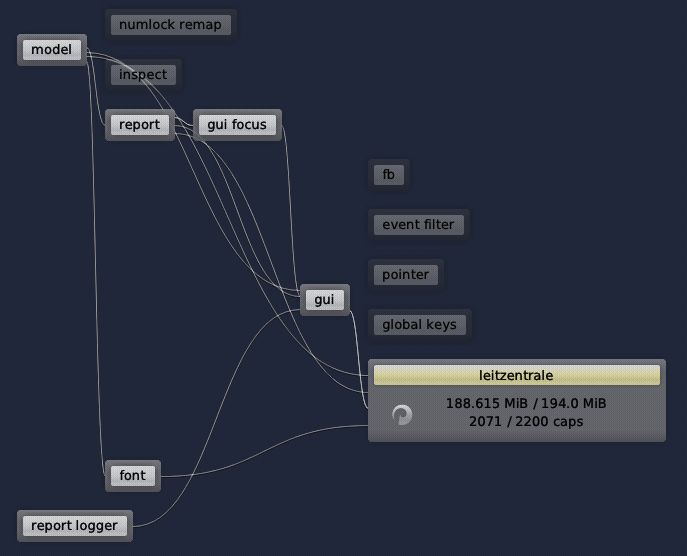
Combined, the option mechanism and the /model/ file system have paved the ground for moving almost all formerly hardwired aspects of Sculpt OS to the deployment level. Even the entire visible infrastructure of Sculpt OS like the GUI compositor, pointer, event filter, clipboard, and the administrative user interface are now under the sole control of the user who can tweak and replace any aspect by editing the model and observing the effects immediately.
|
|
Sculpt OS now lays its entire construction plan into the hands of the user, opening up the system for customization at all levels. The construction plan is not merely a declarative description of the system but it can be live edited at will. Since any change takes immediate effect, declarative system administration becomes an interactive experience.
|
Base framework and OS-level infrastructure
New mechanism for downgrading RAM to read-only access
In situations where ROM modules are dynamically created, they are backed by RAM dataspaces, which are by their nature not read-only. Such ROM servers either had to hand out distinct RAM allocations to each client, or leverage Genode's managed dataspaces to share a read-only copy among multiple clients. But the former is wasteful, and the latter is rather complicated and not fully supported on all kernels.
The current release streamlines the creation of read-only dataspaces from RAM by introducing a new RPC function "seal" to the PD-session interface. For a RAM dataspace allocated by the PD, the seal operation downgrades the dataspace such that any subsequent attachment of the dataspace to an address space will result in read-only mappings. Attachments established prior to the sealing remain unaffected. This way, the original creator of the RAM dataspace is able to keep a writeable mapping while all other peers are downgraded to read-only access. This is useful for ROM services that support version changes of ROMs over time. For ROM services that hand out ROMs with constant data, the RAM dataspace - once filled with content using a temporary attachment - can be detached before sealing. Then, by definition, no mutation can happen while the ROM module exists.
All existing ROM servers have been adapted to use the new interface, thereby making the cached_fs_rom server usable on the Linux and Fiasco versions of Genode. Also all components using the framework's Dynamic_rom_session utility implicitly invoke the sealing mechanism now.
Optimized state reports for human readability
Even though init's state reports were already valued for providing diagnostics at runtime, they left the potential of the HID syntax, in particular its tabular style, unused so far. To make such reports more easy to interpret for human readers, the state of requested/provided sessions is now printed in tabular style using the service type as (leftmost) name of each row. To improve ergonomics further, session states are now abbreviated (e.g., OK instead CAP_HANDED_OUT), yielding more visual space to other details.
Libc inode handling
In Genode's libc, the inode values as returned by stat never carried meaningful information because, in contrast to Unix, there exists no global namespace for those numbers. With multiple file-system sessions of independent VFS servers mounted in one program, inode values can easily clash. Since those numbers were not meaningful anyway, some VFS plugins just return 0. Others use local pointers as (presumably) unique numbers. Whenever using file-system sessions in a nested way, those conflicts are even more likely.
In practice, clashes of inode numbers have sometimes surprising effects when using software ported from Unix-like systems. For example, when opening a second file in vim that happens to have the same inode number as an already open file, vim assumes that the second file is a hardlink to the first and switches to the already open file. That's not what the user expects (there are no hardlinks on Genode to begin with). To discharge such policies and to relieve VFS plugin developers from producing inode numbers out of thin air, we now let the libc create artificial inode numbers by computing a checksum over the path. This way, each file distinctly visible by a program will get a different number (disregarding hash collisions).
Libraries and applications
Qt6 updated to version 6.8.3
Since the Chromium engine of our QtWebEngine 6.6.2 port became too old for the Genode Users Forum, we updated Qt to version 6.8.3. In order to build Qt applications for this new version, the Qt host tools need to be updated using the tool/tool_chain_qt6 script.
Software provided via the Genode-world repository
In line with the plan for the Genode-world repository outlined in release 26.02, more existing ports got converted into Goa projects. In addition, components and pkgs that were hosted in personal Goa project repositories have now found a new home in Genode-world.
Thus the glib library, libvnc, and sdl_vnc are now available as Goa projects.
The imported vnc_server component allows for accessing a Genode system via the VNC protocol and makes use of the libvnc project under the hood.
The imported screenshot component, allows for taking screenshots of a running Sculpt OS.
The imported goa_testbed pkg enables developers to test-drive their Goa projects directly on a running Sculpt OS instance by uploading the ingredients and executing them on target.
A new chrony meta-pkg was created to ease the creation of NTP-based system-clock components, primarily used on machines that do not feature a real-time clock, where the initial time is collected from a remote source. This prompted us to also add the gmp library to the goa meta-pkg as well as this library is necessary on ARM.
Accompanying the Qt 6.8.3 update is an updated QtWebEngine and an adapted Falkon webbrower making use of the new web engine.
LTE modem stack
Having previously dipped into LTE modem support using the Mobile Broadband Interface Model (MBIM) and Huawai's ME906 LTE modem, we were able to gather more experience during the PinePhone enablement which featured the Quectel EG25-G modem.
This lead us to the conclusion that for packet-data connections, LTE modems in general support one or more modes of operation, namely: the Qualcomm MSM Interface (QMI) which is the most widely used, the aforementioned MBIM protocol, or a plain USB-Ethernet interface (ECM/NCM). Additionally, the control channel for each mode is either in binary-message format (QMI and MBIM) or commands can be sent using traditional AT-commands through an USB-serial device.
When working with the PinePhone, we realized that the Quectel EG25-G modem supports all three modes of operation, and therefore, it is the ideal candidate to review and update our LTE modem support while additionally bringing QMI to Genode.
MBIM
Having previously enabled the MBIM protocol by porting libmbim to Genode, it was time to update the library to a current version (1.34.0) and transform it into a Goa project. In order to actually establish a data connection, we had previously written a small mbimcli tool, which now can be found under genode-world/network/mbimcli that also has been turned into a Goa project. Please inspect the README file there for usage information.
Because our Huawai modem also supports MBIM (through an USB configuration profile) we were able to successfully test MBIM there as well as on the Quectel modem (where MBIM has to be configured with an AT-command).
The scenario works as follows: Because LTE modems are exposed as USB devices, Genode's USB-NIC driver (usb_net) needs to be started. When an LTE-MBIM modem is discovered, the driver will initialize the wwan-driver and the cdc-wdm driver for the control channel (see LTE modem support). mbimcli can then access the control channel through a terminal session provided by usb_net, while Ethernet frames are transferred through Genode's Nic-session from the usb_net component to the NIC router. For this to work, mbimcli generates a configuration file for the NIC router. For a more detailed explanation please refer to Johannes' Mobile networking in Sculpt article.
QMI
Analogously to MBIM, we enabled the qmi_wwan driver within our USB-NIC driver, ported libqmi (1.38.0) as a Goa project to Genode, and wrote a small qmicli tool that implements the same behavior as mbicli but uses QMI-library calls instead of MBIM calls. This worked with our Quectel modem almost out of the box.
ECM/NCM
Once a modem is configured as ECM/NCM (done so in our Sculpt OS version for the PinePhone) only the usb_net driver needs to be started. The driver can then be used like any other Ethernet driver on Genode. For configuration purposes, LTE modems expose USB UARTs. One of these UARTs can be used to send AT-commands in order to configure the modem (e.g., setup the APN for the data connection). We expose these UARTs through the "option" driver in usb_net. If an LTE-modem UART is found by the driver, it will request a terminal session for the UART. In case this behavior is unwanted, the terminal session can be routed to Genode's black-hole server.
Testing
MBIM can be tested with the "mobile_network" package offered by jschlatow. For low-level testing, there exist run scripts for both MBIM (mbimcli.run) and QMI (qmicli.run) in repos/ports/run.
Device drivers
Platform driver
The platform driver's shape largely changes with this release. On the one hand, we reorganized the way DMA buffers are administered. Secondly, support for message-signaled interrupts (MSI) and its extended variant (MSI-X) has become explicitly usable and more scalable. We took the necessary modifications as opportunity to tidy up and restructure the platform driver's implementation.
Fine-grained DMA-buffer accounting
Until now, DMA buffer allocation and freeing was a constituent part of the "Platform" service and hard-wired with the related device(s) within one session. This seemed natural because the platform driver has to take care that I/O controlling devices, like S-MMUs or IOMMUs, are configured in a way that these memory portions are accessible by the peripherals. Nonetheless, the accounting of the costs for these DMA buffers was tied to the used platform session too. Components that handle distinct DMA buffers for different clients, e.g. a shared dataspace per client, which a peripheral can directly access, had a hard time to realize separate cost accounting for their clients when DMA buffers and their shared platform session came into play.
Therefore, we've decided to introduce a distinct new service called "Dma", which gets served by the platform driver in addition to the "Platform" service. The administration of DMA buffers got moved to this new service, but contrary to the previous approach, components can now open up multiple "Dma" sessions addressing the same device(s). The platform-driver policy pools "Platform" and "Dma" sessions matching this one policy and, as long as sessions are subject to the same policy, the interoperation of devices and DMA buffers will just work. The opportunity of having one DMA session per client facilitates the resource accounting a lot for drivers that multiplex device accesses, like for instance the GPU or the USB-host driver.
The changes are hardly visible to most developers and users. Mostly when it comes to the routing of the platform driver's service to device drivers, now one needs to be aware that the "Dma" service needs to be routed as well.
MSI and MSI-X support
Message-signaled-interrupts (MSI) and their enhanced MSI-X version are ways to decouple device signaling from classical interrupt lines, corresponding controllers and their pins by using in-band messages on appropriate buses like PCI. MSIs can lower interrupt latency, increase distinguishable interrupts per device, and thereby allow to distribute device driving routines across several CPU cores.
In the past, the usage of either an interrupt, MSI, or MSI-X was transparent to the device driver. In general, the platform driver exposed the interrupt pins available. But if a device was capable of using MSI or MSI-X, one of these mechanisms was selected under the hood. To the client, a general IRQ service got exposed while the type of interrupt remained hidden.
Just providing one interrupt regardless of the actual mechanism being used is a simple solution for simple drivers. The downside is: drivers cannot profit from the potential of having several multi-core distributed interrupts. Additionally, often device-driver manufacturers have singular knowledge about circumstances where MSI or MSI-X are malfunctioning, and should not be used. Last but not least, we experienced ported device drivers where the legacy interrupt handling part wasn't working as stable as the MSI variant anymore. Most probably, because it isn't tested in practice.
Finally, we decided to expose all knowledge about available interrupt options to the client of the platform service, and let the client decide which one to use. Moreover, the platform service got extended to enable clients to allocate more than one MSI-X dependent on the abilities of the device.
A typical devices ROM a client might observe might look like the following:
 + device 00:06:0 | type: pci | used: false | msi: 1 | msi_x: 32
   + irq | number: 5
 ...
The device driver utilities used by all drivers of the framework, which can be found at repos/os/include/platform_session/device.h remain compatible Therefore, current drivers don't need to be touched as long as there is no pressure to explicitly make use of a specific interrupt variant.
The Platform::Device::Irq utility - if used as before - will determine what kind of interrupt is supported and will use either MSI-X, MSI, or normal IRQ in that order of preference. Additional constructors of the very same utility class allow developers to explicitly decide what interrupt to use, respectively how many.
Linux device-driver environment (DDE) updated to kernel 6.18.19
We continued the process of updating our DDE Linux based drivers, moved to a more recent LTS version (6.18.19) and concluded the update of pc_linux and thus all pc driver components.
During the update, we consolidated the inner workings of various DDE Linux variants to align them more closely in an effort to minimize differences to simplify a future updating endeavor.
This release also brings initial MSI/MSI-X support to DDE Linux as further enhancement. Pretending that devices only feature support for legacy interrupts and configuring our emulation environment accordingly while letting our platform layer handling MSI transparently worked well in the past. However, with more recent wireless network devices, this approach was not as prosperous. For example, we could get Intel BE201 WiFi to work only when explicitly using MSI-X.
The explicit MSI support allows DDE Linux PCI drivers to pick the type of interrupt to utilize now. Naturally, the available types of interrupts are still managed by the platform driver but now the driver is free to operate best to its abilities. In return, we benefit from less uncertainty where it was not always clear if unexpected behavior of drivers stemmed from mismatching interrupt delivery mechanisms.
Updated ACPICA support
The ACPI Component Architecture project ACPICA develops and maintains an operating-system-independent reference implementation of ACPI, which can be used by operating systems like Genode to utilize the full functionality of modern PCs. We updated the port on Genode to a recent version in order to support modern notebooks better. Specifically, the battery report via the ACPI _BIX format is now supported.
AHCI
With the help of our community, we were able to address a long-standing issue (5088) where AHCI controllers would not reset during driver startup. It turned out that this behavior was caused by the BIOS/UEFI handing over a half configured controller where the FIS-receive DMA engine was still configured and running. Disabling the engine before HBA controller reset solved this problem, which should lead to more hardware being supported by Genode.
Intel Sound Open Firmware
Starting with Generation 11 (Tiger Lake), more and more Intel-based laptops have made use of additional DSPs for handling various audio related tasks that require additional device-driver components. While previous HDA (Azalia) drivers still work for the core audio interface, devices like the internal DMIC microphones or HDMI-based audio connectors are not detected.
Sound Open Firmware is an open standard that drives recent HDA devices and requires, as the name suggests, Intel provided firmware to be loaded onto the DSP in question. We already ported the Linux SOF driver over to Genode some years ago but kept it on a separate topic branch because it was tied to one specific laptop model.
With Genode 26.05, we finally release the first version of the pc_audio driver that makes use of Genode's Record and Play sessions with the goal to support more platforms and devices in the future. For information on how to configure/use the driver please consult the README file at repos/pc/src/driver/audio/pc/README.
I2C-connected touchpads
Touchpads or trackpads are the primary pointing devices of mobile PCs. While the actually installed devices are quite diverse, the firmware typically used to provide uniform access via PS/2 mouse emulation in the past. In modern notebooks (since Intel Tiger Lake), this emulation has become less reliable resulting in jumping or stuck pointers due to erratic input events. Therefore, we had to deal with the actual device interface when enabling the first Tiger Lake platform in 2022 and implemented an experimental Linux-based driver, that serves the touchpad option in Sculpt OS.
From the OS perspective, touchpads appear as I2C Human Interface Device (HID) quasi-standard devices. HID (known from USB devices) comprises a wide range of input devices on I2C too, but we practically addressed touchpads and touchscreens only. Thus, the complete picture not only comprises the actual HID driver but also drivers for Intel's Low Power Subsystem (LPSS) I2C bus and the GPIO host controller for PIH-based interrupts as well as substantial discovery of ACPI device resources. As Genode's ACPI support does not meet the requirements of the latter, the current pc_i2c_hid driver combines the driver modules into one component but requires the following parameters that vary per notebook model from offline ACPI discovery as configuration elements.
 + config
   + i2c_slave  | irq: 266 | bus_addr: 44 | hid_addr: 32 | gpio_chip: INT34C5  | . Fujitsu U7411 (SYNAPTICS)
   x i2c_slave  | irq: 128 | bus_addr: 44 | hid_addr: 32 | gpio_chip: INTC1083 | . HP ZBook Core Ultra Series 2
   x i2c_slave  | irq: 104 | bus_addr: 93 | hid_addr: 1                        | . StarLabs StarLite V
   + i2c_master | bus_speed_hz: 400 | + fmcn | hcnt: 193 | lcnt: 313 | hold_time: 80 | . Tiger/Alder/Raptor Lake
   x i2c_master | bus_speed_hz: 400 | + fmcn | hcnt: 115 | lcnt: 120 | hold_time: 35 | . Meteor/Arrow Lake
   x i2c_master | bus_speed_hz: 400 | + fmcn | hcnt: 106 | lcnt: 213 | hold_time: 80 | . StarLabs StarLite V
The i2c_slave node defines the touchpad device by its I2C bus address, HID descriptor register address, and interrupt source. For GPIO pin-based interrupts gpio_chip specifies the controller model and irq the PIN to use. If gpio_chip is not specified, the platform interrupt irq is used. The i2c_master nodes specifies properties of the I2C controller itself.
The touchpad driver supports platforms from Tiger Lake to Arrow Lake with a range of discovered configuration parameters for concrete device models that can be enabled on demand. Due to the fairly timing-sensitive initialization phase of the Linux implementation, the driver defers responses to Genode's heartbeat mechanism until the touchpad was successfully detected. So, you may enable the heartbeat monitoring when integrating the component like the Sculpt option does to automatically restart the driver.
 config
 + heartbeat | rate_ms: 2000
 + start pc_i2c_hid | caps: 130 | ram: 8M
   + heartbeat | restart_after_skipped: 4
In the future, two major concerns of the current driver must be addressed. First, the GPIO host controller driver must be moved into a separate component to provide pin access to other drivers like ones for audio AMP companion chips of Intel HDA or fingerprint sensors. Second, the manual configuration of ACPI-based parameters must be replaced by boot-time or runtime discovery.
Wifi
We added support for Intel Wireless BE201 devices by enabling the iwlwifi MLD driver in our DDE-Linux-based pc_wifi driver.
As a long-standing shortcoming, we also addressed the handling of invalid characters in SSIDs and passphrases, which are just byte strings in the WiFi standard. Those are now encoded in the printf-escaped format used by wpa_supplicant. For convenience, we provide a utility that translates UTF-8 strings to and from the encoding and is used, for example, by the network dialog in Sculpt OS.
Display rotation and flipping for VESA and EFI boot framebuffer
The VESA framebuffer driver and boot framebuffer got enhanced to support rotation and flipping, to report and to consume the same configuration format as the Intel display driver. With those extensions, both drivers can be used in Sculpt with the same UI to interactively rotate and flip the display content. The feature is practically relevant for the Steam Deck where the display content needs to be rotated to be usable.
Platforms
Linux
For running network scenarios on base-linux, our established solution was to use a Linux-specific network driver that ties to an existing tap device on the host system. While this is a simple and robust solution, it requires root permissions for setting up the host system accordingly, which is quite onerous when using the Goa SDK on different host systems.
In order to eliminate this point of friction, we took QEMU's user-mode networking as an example and implemented a network driver based on QEMU's libslirp. The new linux_slirp_nic component is now used by the Goa SDK by default. The configuration options are documented in the component's HSD file.
Build system and tooling
Support for using Sequoia PGP
Genode's depot tools use GnuPG for signing archives and for the verification of downloaded archives. With Sequoia PGP as an alternative implementation of the OpenPGP standard reaching maturity, we added support for Sequoia PGP to our depot tools.
If the sq binary is available in version 1.2.0 or later, the publish and download tool will use Sequoia PGP instead of GnuPG. As Sequoia uses gpg-agent as a fallback backend, no user action is required. However, you may also import your secret key into Sequoia's keystore to eliminate this GnuPG dependency.
Goa SDK
In line with the recent release of Sculpt 26.04, we updated the built-in version information. You can switch to the new version with Goa's update-goa command:
$ goa update-goa 26.04
As announced in the release notes 26.02 the updated Goa SDK now employs the flattened structure of the pkg/ and the new --only-tests option.
In addition, we also added support for Sequoia PGP to Goa's copy of Genode's depot tools. This also included adaptations to the add-depot-user command: We renamed the --gpg-user-id argument to --user-id and added a --fingerprint argument.
Furthermore, the new Goa SDK comes with a bouquet of smaller changes:
-
As mentioned in Section Linux, Goa now uses the libslirp-based network driver by default.
-
The --run-as <name> argument has been replaced by --genodelabs-user <name>. The new argument extends the scope to archives referenced by the pkg/archives and used_apis files.
-
We adapted the bump-version command to the usage pattern employed by the genode-world repository. First, genode-world defines archive versions in a central goarc file instead of version files inside each project directory. Second, genode-world prefixes each archive with the upstream version of the ported library/application. The modified bump-version command now preserves version prefixes and refrains from creating a version file if any version of a project's archive is specified in a goarc file.
-
We added support for versioned symbols to the extract-abi-symbols command, which previously failed if a shared library contained any versioned symbol.
-
We removed support for overriding the project_name and project_dir variables in goarc files due to unintended side-effects and negligible benefit.
-
We removed support for runtime specifications that provide an "Uplink" session. As Goa allows the customization of its internal NIC router configuration since Sculpt 24.04, this feature is not in use anymore.
-
The two-staged build process for Meson projects has been removed in favor of using a GCC spec file. We had already applied this approach to the other build systems in 26.02.
-
For CMake-based projects, Goa now generates a boilerplate Find*.cmake file for every archive defined by the used_apis file unless the archive already contains such a file. This removes the need to add those boilerplate files to every individual api archive.