


Release notes for the Genode OS Framework 26.02
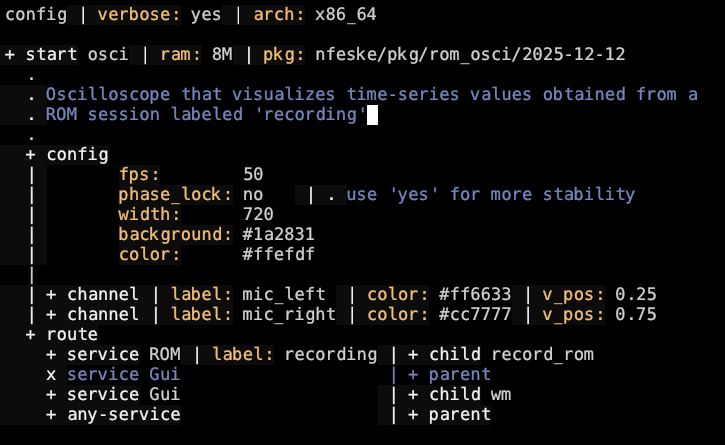
With version 26.02, we celebrate a new human-friendly way of interacting with configurations and other structured data. Our custom designed human-inclined data (HID) format evolved during two years of experimentation and practical evaluation, while having taken each single use case encountered in the Genode-based Sculpt OS as input. With the final touches, tooling, and documentation added during the release cycle, Genode 26.02 finalizes the format and consistently replaces the use of XML by HID (Section Human-inclined data (HID) format by default).
Speaking of transitions, as planned on our roadmap, we completed the first half of the project's migration from GitHub to Codeberg. Section Migration from GitHub to Codeberg describes the intermediate state and provides practical guidance for users and contributors.
The technical topics of the release revolve around the progressive update of our Linux device-driver environment (DDE-Linux) to kernel version 6.18 (Section Linux device-driver environment), usability improvements of the Goa SDK (Section Goa SDK), input-event processing (Section Event filter), and code rigidity (Sections API refinements and Execution on bare hardware (base-hw)).
Feature-wise, version 26.02 further cultivates the genode-world repository as designated place for ported 3rd-party software, adding the port of Git as stepping stone on our way towards self-hosted development on Sculpt OS (Section Software provided via the Genode-world repository).
Human-inclined data (HID) format by default
Throughout the past year, we have thoroughly evaluated the potential replacement of XML by a custom alternative optimized for human use and understanding. As part of the evaluation, we published an experimental variant of Sculpt OS to gather practical experience and feedback, which in turn allowed us to gradually refine the format into its final form over the past few months. With the current release, we have now switched the Genode OS framework to the new HID format by default.
- Human-inclined data (HID) documentation
|
|
Genode's new way of textual configuration
|
The switch entails all run scripts, Sculpt OS, the Goa SDK, all automated tests, and all depot packages provided by Genode's main repository. It goes without saying that such a transition would have been unrealistic without adequate tooling. This is where our HID-processing tool at tool/hid came into play, which we enhanced iteratively since October. The tool has not only become able to convert between XML and HID but to retain comments of different kinds. It thereby largely reduced the conversion work to final retouching, supplementing human taste and intent as a post-processing step.
The HID tool has also become the natural solution for validating data against schema definitions. Driven by concisely expressed data schemas that blend formalism with human-readable documentation, the new check command aids the offline validation of configurations. Genode's run tool leverages this facility whenever a schema (.hsd) for a given component exists, providing a safety guardrail similar to the formerly used .xsd files.
The HID-based .hsd files lend themselves to become hosts for documentation that is traditionally kept in README files. Hence, over time, we plan to replace free-form READMEs by semi-formal yet human-readable .hsd files. This, however, is not today. At the current time, the README files of the framework still speak of XML. This will be rectified in concert with the revision of the Genode books in the upcoming release 26.05 in May.
Note that even though XML is no longer used by the framework, Genode will retain support for XML in addition to HID until version 26.08 as scheduled for August.
Migration from GitHub to Codeberg
As outlined in our road map, we migrated all but the main (genode.git) repository from GitHub to Codeberg. From now on, you will find all genode-* repositories as well as the Goa repository at
- Genode Labs at Codeberg
Along with the git repositories, all issues, pull requests, and comments have been migrated as well. The repositories at GitHub have been made read-only and therefore will not receive any updates. In the course of the migration, we have also changed the name of the default branches from "master" to "main".
In order to adapt to these changes on your side, we advise you to switch to the current master branch in your clone of https://github.com/genodelabs/genode.git and follow the instructions that are printed by any build command. For Goa, you can trigger the migration with the following commands:
 goa update-goa master
 goa versions
Note that the migration to Codeberg implies a few more changes for contributors: Contributors must create an account at codeberg.org. It is possible to link the new account to your GitHub account. This enables Codeberg to associate your former comments (entered on GitHub) to your new account on Codeberg (i.e., you may use different user names on both platforms). In case you forked any repository on GitHub, you should consider creating a new fork on Codeberg and manually pushing your branches and tags to the new fork to restore the state of the forked repository as it was on GitHub. The following instructions serve as a guideline:
 git clone --bare https://github.com/<user>/<repo> bare_clone
 cd bare_clone
 git branch -m master main
 git remote set-url origin ssh://git@codeberg.com/<user>/<repo>
 git push --mirror
Codeberg uses Forgejo and has a very similar UI compared to GitHub. However, there are a few changes when it comes to referencing issues and commits. On Github, you are able to push a commit referencing an issue via #<issue-number> to your fork and this commit will be shown in the corresponding issue of the original repository from which you forked. On Codeberg, however, you must explicitly mention the repository where the issue resides via, e.g., genodelabs/goa#<issue-number>. Similarly, if you want to reference a commit from a fork in an issue comment, you must name the fork explicitly, e.g., jschlatow/goa@<commit-hash>.
Base framework and OS-level infrastructure
API refinements
New Align argument type
The Align type defined at util/misc_math.h is meant to be used as argument for aligned allocations and replaces the former use of basic unsigned values. Typical argument values AT_PAGE, AT_16_BYTES, AT_MWORD are now defined by the public API. Whenever an alignment value is passed around, the type name fittingly describes the purpose of the parameter. When using a specific alignment, the notion { .log2 = 10 } nicely expresses the meaning of 10 as a 2^n exponent.
Removal of memset
Raw memory-clearing via memset has arguably been a rarity throughout the framework. As almost all of these calls used to specify 0 as fill character, we have now replaced memset by bzero. The latter has a narrower interface and no return value. Still, calls of bzero rightfully remain a rarity.
Removed diag session argument
Core's diag feature had been a useful debugging aid during the introduction of cap-quota accounting and trading around version 17.05. Given that the feature has remained unused ever since, we have removed it.
Removed UART session interface
The UART session interface was introduced in version 12.11 to extend the terminal session interface with the ability of setting the baud rate. This was long before the configuration-based server-side policy selection became the predominant pattern for out-of-band concerns like this. Since the split of session interfaces between terminal and UART is no longer justified, the UART session got removed now.
VFS library
The VFS infrastructure at include/vfs/ has now become part of the Genode:: namespace, which alleviates the need to prefix Genode types inside the Vfs.
Each VFS file-system type now lives in a dedicated namespace prefixed with Vfs_, which includes the Genode and Genode::Vfs namespaces. This gives each VFS plugin a natural place for custom types, flattening the type hierarchy in cases where a compound file system is constructed.
Linux device-driver environment
This release features the first step of updating the Linux version of our device-driver environment to a recent 6.18 LTS release. In particular, we updated all virt_linux-based components. This includes the TCP/IP stack, USB-client-device drivers like usb_hid, usb_net, and usb_serial as well as our WireGuard port. The usb_serial component has now become available for ARMv8.
Changes to the internal structuring within Linux prompted us to adapt our Linux emulation environment and guard those changes with kernel version checks to keep them compatible with components that for the moment still rely on an older Linux release.
We also decided to drop support for ARMv6, which only concerns support for the Raspberry Pi 1, as this platform has not seen much use in recent years and its practical relevance is debatable.
As of now, the update of virt_linux to 6.18.5 is complete, while the update of pc_linux is at the starting block. We consider bumping the LTS version during this line of work to closely track the current LTS release.
TCP/IP
Genode's libc expects correct error values when using POSIX sockets. These error values are obtained through the _vfs_ip_-plugin which communicates directly with both IP stacks (lwIP and lxip). Up until now, we have tried to tunnel all socket errors through the file-system session which led - because of the limited error states of the session - to heuristics and emulation at the libc side. Because both IP-stacks now implement the socket C-API, and therefore, return unified error codes, we changed this behavior by writing the error codes to a dedicated error file for each socket. The libc now retrieves a socket error from the file and translates it to the corresponding libc errno. This change results in improved compliance with the POSIX standard. Additionally, we made sure that both IP-stacks return consistent results while also enhancing our testing infrastructure with common usage patterns like recv with MSG_PEEK set on a non-blocking socket as used for connection status testing.
Event filter
The global-key feature of the Nitpicker GUI server facilitates the implementation of global key combinations, for example, the window manager's KEY_SCREEN shortcuts. While the global key is pressed, all subsequent input events are passed to the configured handler of the global key until all keys are released. This effectively removes those input events from the event stream of the current focused component. Thus, an outside observer cannot detect key combinations while leaving the event stream unmodified and usable by the focused Nitpicker client. An example use case of such an observer would be a global screen lock that is activated whenever Win+L is pressed while the Win key is also handled by clients (e.g., a virtual machine).
In this release, we enhanced the event-filter component to support the reporting of shortcuts if configured key combinations are observed. The key events are preserved for further processing (they are not filtered out).
 + report
   + shortcut screenshot
     + key KEY_LEFTMETA
     + key KEY_S
   + shortcut screenlock
     + key KEY_LEFTMETA
     + key KEY_L
The example configuration declares two shortcut reports named screenlock and screenshot. The event filter creates two report sessions labeled after the shortcut names and reports each occurrence of the combinations. The report provides the shortcut name and a unique serial number as attributes as follows.
 shortcut screenshot | serial: 7
 -
Report observers must record the last observed serial number for comparison on later report updates. The first serial number and future changes of its value shall be interpreted as shortcut events. Note that reports missing a valid serial attribute must be ignored.
Software provided via the Genode-world repository
Housekeeping
The runtime files of the Goa projects maintained within the Genode-world repository have been converted from XML to HID.
In addition, the run scripts currently used for CI testing also received the HID treatment and - to clarify their role - have been moved to Genode's repos/ports/run/. The legacy portion of the Genode-world repository is slated for removal in summer of 2026.
New port of Git
The Git version control system is an essential tool in our Genode development workflow. Following our roadmap towards self-hosted development on Sculpt OS, we have now added a port to the genode-world repository.
Seoul VMM
The Seoul VMM got adjusted to become interoperable with the Goa SDK. All Genode-specific code located in genode-world has been moved to the Seoul source repository and a make-based build environment was crafted. The new Goa project imports this modified Seoul repository and uses a Makefile to build the VMM.
FIO benchmark
A port of the well-known flexible I/O tester joins the Genode-world repository. Among others, it is used to exercise the I/O aspects of our POSIX runtime.
Platforms
Execution on bare hardware (base-hw)
Genode's custom kernel now exports additional information when collecting execution times of subjects in the system via the TRACE service. Beforehand, execution times of all threads got collected. Now when using hardware-assisted virtualization, the CPU usage of virtual CPUs is tracked too. Moreover, subject properties of the new scheduler introduced in release 25.08 are also getting exposed. Namely, the weights and warp values of the individual threads and virtual CPUs.
The effort to steadily keep and enhance the code quality of our custom kernel presses on, this time by reworking the kernel's internal interrupt representation, as well as the allocation of hardware-based address space identifiers. A failure of the latter gets now reflected to upper layers of the system.
Linux
For test-driving interactive system scenarios on Linux, Genode employs the fb_sdl component as pseudo display and input driver. In version 23.11, it received an update to SDL2. The current release adds principal support for SDL3. Whereas the time-tested version 2 is still used by default, version 3 can now be selected by setting the environment variable GENODE_FB_SDL_VERSION to 3 at build time.
Build system and tooling
Goa SDK
Following the spirit of this release, we converted all examples provided in the Goa repository from XML to HID, and made HID the new default. Furthermore, we integrated schema validation of runtime files, index files, runtime configs (against init.hsd) and component configs (determined by depot-provided .hsd files).
With the move of genode-world towards Goa, we also reflected on the structure of Goa's project directories. Since day one, Goa provided for multiple pkg definitions in a single Goa project as subdirectories under pkg/, which has rarely been used in practice. We therefore removed the substructure of the pkg/ directory so that the runtime, archives, and README files are now supposed to be placed in the pkg/ directory directly. In the meantime, Goa has been enabled to detect, build, and export Goa projects that are referenced as dependencies. Dependent runtimes can therefore be hosted in arbitrary subdirectories instead. For instance, a test/ subdirectory can be used for defining a Goa project as a test case for the parent project. This test case can be run by executing goa run -C test from the parent directory. Note that the name and hierarchy of the subdirectory is arbitrary. However, we actually decided to give any test/ directory a special meaning: Whenever Goa is run recursively via goa -r, it ignores any project that has a /test/ path element so that test cases can be easily ignored for publishing. For running tests, we added the --only-tests command-line switch that inverts this logic.
With the scenario of nested Goa projects in mind, we also removed the possibility to modify the project name and directory via goarc files, which did not make much sense anymore. If needed, one may resort to symlinks instead.
Last but not least, we reflected on the way how Goa passes the required linker flags and libraries to 3rd-party build systems. So far, we used environment variables such as LDFLAGS and LIBS to achieve this. Yet, not all 3rd-party projects, especially projects with custom configure scripts, make use of these variables. We eventually found GCC spec files to be a robust alternative to environment variables that reduce the need for patching. We already applied the new approach to Goa's support for autoconf, make, cmake, qmake, and cargo.
Note that not all the aforementioned changes entered Goa's 25.10 branch. In order to maintain compatibility with Sculpt 25.10 and corresponding Goa projects, we omitted the switch towards using HID by default and the flattening of the pkg/ directory from the 25.10 branch and only added it to the main branch. You may conveniently switch between both branches with the following commands:
 goa update-goa main
 goa update-goa 25.10
Run-tool support for AMT TLS
With newer versions of Intel's Active Management Technology (AMT), using TLS is mandatory. So we extended our run-tool plugins that deal with AMT to capture serial messages as well as to power-cycle the machine in question.
The RUN_OPT flag --wsman-tls switches turn on TLS when set to yes, the default is no.
The RUN_OPT flag --amtterm-tls enables the use of TLS when set to yes, the default is no. As TLS SoL requires the host's certificate, downloading and placing it into the build directory beforehand is vital.
The following command can be used to obtain the certificate:
openssl s_client -connect <host>:16993 < /dev/null | openssl x509 > <host>.cert
It might also be necessary to activate the serial redirection. The following command illustrates how to perform this operation using the wsman-cli program:
 wsman --https --endpoint https://admin:<password>@<host>:16993 \
       --noverifypeer --noverifyhost \
       put http://intel.com/wbem/wscim/1/amt-schema/1/AMT_RedirectionService \
       -k ListenerEnabled=true